Trond and Ellen
Out Stealing HorsesTrond and Ellen are a father and adult daughter whose estrangement is made tangible by silence, distance, and the absence of a telephone. Ellen’s unannounced visit to Trond’s remote home forces him to face what his chosen solitude has cost their relationship: he has not been there when she needed to speak, yet the possibility that she might leave and never return fills him with immediate fear. Their reunion does not resolve the past, but it changes the house and leaves open a way for them to find one another again.
Separation and the cost of absence
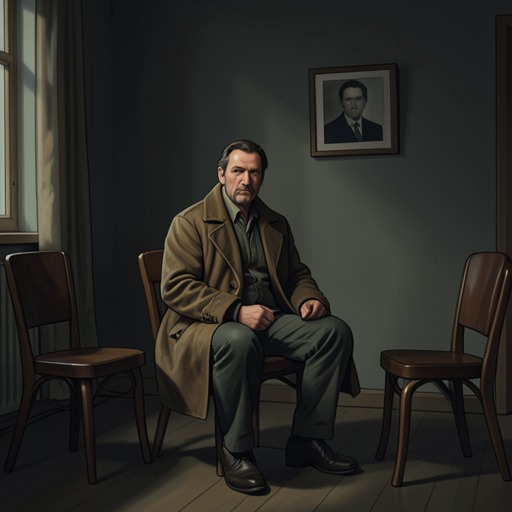
Ellen is the elder of Trond’s two daughters, and he calculates that she is thirty-nine when she appears at his home. He has not seen her for at least six months and, since moving, has not spoken with her; in fact, the silence had begun even earlier. Trond admits that he has not given much thought to either daughter amid everything else in his life. The admission is not presented as a deliberate rejection so much as a measure of how thoroughly he has retreated from ordinary human contact.
That retreat has a history. Trond’s wife and his sister died within the same month, and the losses helped turn conversation with other people into something he no longer knew how to manage. He says that one reason for living alone is that he does not know what to talk about; another is the forest, whose place in his life had once been profound before it disappeared from it for a long time. His move is therefore bound both to bereavement and to a return toward a landscape he had missed. Yet the refuge he has chosen also distances him from Ellen. His solitude may be necessary to him, but it has become a barrier she must cross without the ordinary means of contacting him.
The novel connects this present absence to an earlier pattern of separation. Trond remembers periods when he travelled for much of the year and returned to find both girls grown; they would sit quietly on the sofa, watching the door in expectation of his arrival. He recalls that their waiting made him feel confused and uneasy. In the present, Ellen’s visit brings that remembered image of children watching for their father into contact with the adult daughter who has had to search for him herself.
Ellen finds him
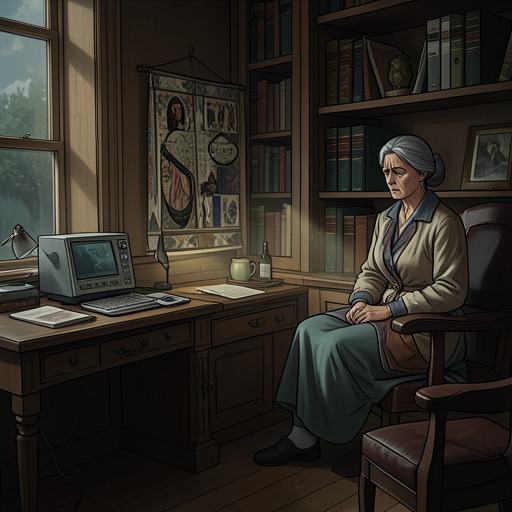
Ellen reaches the forest after weeks of trying to discover where her father lives. She has called town councils across an area of eighty miles and beyond, because Trond has no telephone. She leaves around seven in the morning, after the people who are meant to leave the house have done so, and drives for a little over an hour. She has slept badly and has taken the day off, a decision she made long before setting out. The practical details give her visit the weight of a deliberate effort: Trond did not make himself easy to find, and she persisted until she could reach him.
She arrives in a white Mitsubishi Spacewagon while Trond is out in the woods by the lake. He has not heard the car, and when he comes up the slope he sees a fair-haired woman in a dark coat waiting beside it. Lyra runs to her first. Although the dog and Ellen do not know one another, Lyra accepts her readily; Ellen is fond of dogs, and Trond remembers that she had a brown dog when he last visited her. That small recognition offers a point of familiarity before father and daughter have found their footing with each other.
Ellen’s cigarette is another detail that makes her recognizable to Trond: she holds it in her stretched fingers away from her body, as if it belongs to someone else. He sees that she is still attractive and thinks of her mother’s good looks, but the recognition that matters most is in the familiar gesture. Trond greets her with a smile. Ellen’s half-smile soon fades; after he explains that he had been in the woods, she stubs out her cigarette and steps forward to embrace him. She holds him tightly and calls him her old dad, saying that it is good to see him. Trond returns the greeting, while registering that her height and the closeness of the embrace bring back the years when the girls seemed to grow each time he came home.
A visit that tests the refuge
The reunion makes visible the mismatch between Trond’s preference for silence and Ellen’s need to reach him. She tells him that finding his address took weeks and reproaches him for having no telephone. Her complaint is affectionate as well as exasperated: she has gone to considerable trouble to find him, while he has allowed himself to become difficult to contact. The visit asks whether his withdrawal is simply a private arrangement or whether it has also left his daughter shut out.
That question becomes explicit when Ellen asks whether he would rather she had not come. She wonders aloud whether he moved there to be left in peace and whether her arrival, early in the morning, is an unwelcome disturbance. She asks with her back to him, gripping the edge of the worktop after setting down the cloth she has used to wipe spilled milk from the table. Her posture and the pause before Trond answers make the question more than a request for reassurance: she is trying to understand whether his new life has room for her at all.
Trond initially cannot answer. He explains that he changed his life because he could not go on as before: he sold what remained of the firm and came to the forest because otherwise things would have turned out badly. That account explains the urgency of his move without telling Ellen whether he wants her there. When she asks again, he admits that he does not know what to think. Then the thought that she might go away and never come back strikes him with such force that he quickly tells her not to go. His answer reveals what his uncertainty had concealed: he values his solitude, but he is afraid of losing contact with his daughter.
Ellen says she had not intended to leave, at least not yet, and turns from the sink. She suggests that he get a telephone. Trond promises to think about it, honestly, though he does not promise to act. The exchange leaves their disagreement unresolved: Ellen has identified a concrete way to make contact possible, while Trond remains cautious about changing the life he has arranged. Still, the moment marks a shift from the question of whether she is welcome to the practical question of how she might reach him again.
The meaning of the visit
The hours Ellen spends at the house alter its atmosphere. She chooses to walk with Lyra while Trond rests in bed for half an hour. By the time she leaves, darkness is beginning to return. She starts the car with the door open and tells him that she now knows where he lives. Trond says he is glad she does. After she waves and drives down the slope, he turns off the yard light and goes back inside. Lyra follows, but the kitchen feels somewhat empty, and the dark window reflects only Trond.
The departure holds both connection and its limits. Ellen has found him, hugged him, walked his dog, and stayed for several hours; she has also gone home, and the silence between visits has not yet been replaced by a settled routine. The newly established fact that she knows his address is modest but consequential. Her search has made contact possible, and Trond’s response to the prospect of her permanent departure shows that her presence matters even to a man who has chosen to live apart from other people.
The visit also brings Trond’s absence into sharper focus through his response to Ellen’s thoughts about David Copperfield. She describes the fear that a person might somehow fall out of her own life while someone else took her place. Trond recognizes the terror in that idea because he has read the novel’s opening lines in a similar state of fear, needing to continue until the story sets things right. But he also acknowledges that real life is different from a book and reflects that he was not there when Ellen needed to talk. Her words disclose an inner life he did not know about; his recognition of it comes alongside the painful knowledge that she had not been able to share it with him.
In retrospect, Trond sets the visit beside the final days he remembers with his father, when movement through the forest and across the border into Sweden became inseparable from what came afterward. He now says that the past no longer feels like a foreign country he is obliged to inhabit at a distance: he can enter memory and feel the ride through the forest in his body. Ellen’s departure returns him to the present, alone in the kitchen, but her visit has entered that present too. Their relationship remains shaped by missed years and imperfect knowledge; nevertheless, the fact of her arrival, and his fear when he imagines her gone, make the silence between them newly permeable.